Your slide.
Your call.
A guided workspace for soil-microscopy assessment. You keep the judgement, and the report you give a client stands up to questions.
- Present
Bacteria
reviewed · 12 FOV
- Present
Fungi
reviewed · 12 FOV
- Present
Protozoa: flagellates
reviewed · 12 FOV
- Absent
Protozoa: ciliates
reviewed · 12 FOV
- Not assessable
Nematodes
sample degraded
- Undecided
Oomycetes
4 of 12 FOV
Illustrative class review: each organism class is worked through to a decision, and the report stays blocked until all are decided.
Five steps, one screen at a time.
- 01
Sample
Register the sample and its context once. No spreadsheet running alongside.
- 02
Upload
Fields of view, in the order you shot them.
- 03
Annotate
One organism class at a time, each recorded as present, absent, or not assessable with a reason.
- 04
Counts
Bacterial and nematode counts recorded against the same session.
- 05
Report
A client-ready report, generated once the assessment is complete.
Beneficials and pathogens alike.
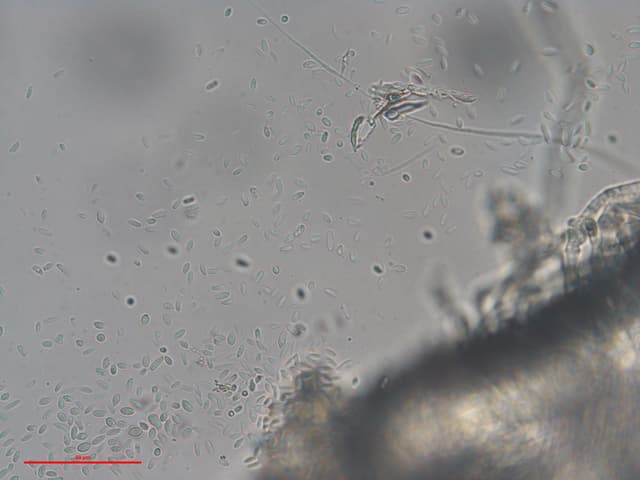
The organism classes an assessment works through, one at a time. Real microscopy from open datasets, with the original attribution preserved beside each plate.
 Sample 78
Trichoderma harzianum
Beneficial inoculant · biocontrol agent
Zenodo 10.5281/zenodo.7965200 · CC-BY 4.0
 Sample 04
Fusarium spp.
Soilborne pathogen · biocontrol target
Zenodo 10.5281/zenodo.7965200 · CC-BY 4.0
 Sample 106
Verticillium dahliae
Soilborne pathogen · strawberry / cotton
Zenodo 10.5281/zenodo.7965200 · CC-BY 4.0
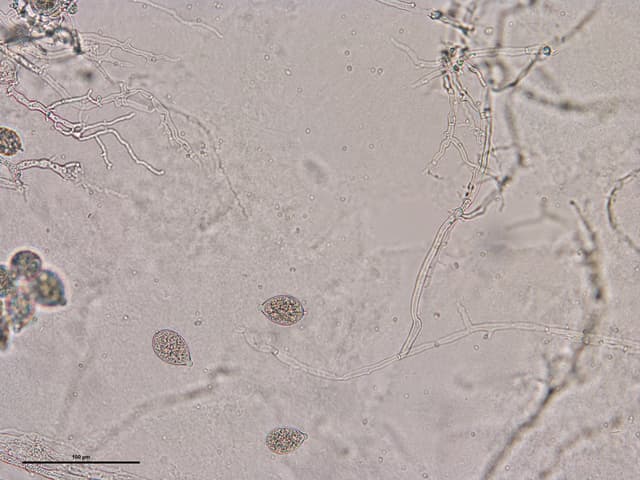 Sample 64
Phytophthora spp.
Oomycete pathogen · potato / forestry
Zenodo 10.5281/zenodo.7965200 · CC-BY 4.0
A report that is complete and current.
Complete, or it does not leave
A report will not generate while any required organism class on any included field of view is still undecided. Half-reviewed slides do not become client documents.
Current, provably
A report is released only when a fresh check confirms it reflects your latest edit. If you change a count after generating a report, the old version can no longer be downloaded.
Yours alone
Two tabs or two devices cannot overwrite each other's decisions. The work you signed off is the work that ships.
The software does the bookkeeping. You do the biology.
Assisted detection makes proposals and you decide. You accept, correct or reject each one, and your correction is the record.
The assist supports your judgement and does not replace it. The workflow guarantees that your work is never lost, that an incomplete assessment is never released, and that a client never receives an outdated report.
What stays with you.
Your name on the report
The assessment is yours, and the report states clearly who made the call.
Measures we stand behind
The report includes only the measures we can support with confidence.
Your microscope, your method
SoilFlux is the workspace around your microscope: capture, decide, record and report, so your expertise reaches the client in a form they can act on.
Put a real slide through it.
Early access is open to practising consultants and labs. The best first session uses a sample you have already assessed, so you can compare the record with your own judgement.